Texts
The texts collected here reflect an ongoing inquiry into perception, space, and silence, written alongside the painting practice.
Landscape, in these works, is not approached as an external object but as a lived condition.
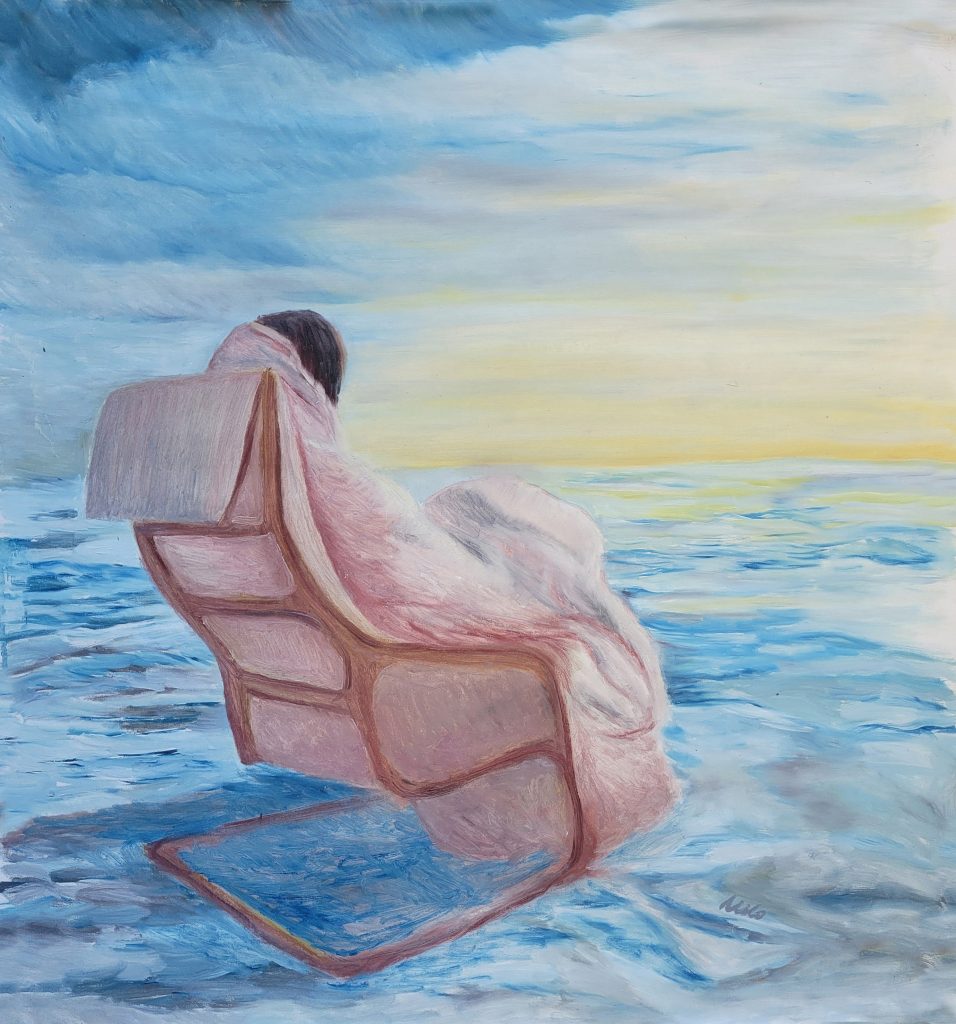
Rather than representing nature, the paintings operate within it as a perceptual field—one that unfolds through stillness, duration, and embodied attention. Snow, water, altitude, and traces of human presence function as thresholds between the visible and the felt, between what appears and what remains latent.
Gaston Bachelard wrote of space as something experienced from within, shaped by memory, reverie, and intimacy. In this sense, landscape here becomes a site of inner habitation. Snowfields are not empty surfaces but zones of suspension; water is not movement but absorption; altitude is not elevation but distance from immediacy. These environments slow perception, allowing space to be sensed rather than surveyed.
Maurice Merleau-Ponty understood perception as inseparable from the body—seeing not as observation from a distance, but as participation. The paintings follow this logic. They do not invite interpretation through narrative or symbolism, but through presence. The viewer is not positioned outside the image, but quietly drawn into its temporal rhythm. Looking becomes a bodily act, attentive and restrained.
Human presence appears indirectly: through traces, interruptions, or absences. Footprints, cuts, objects, and altered surfaces suggest interaction without depiction. This displacement resists spectacle and centers vulnerability. What matters is not what happened, but that something passed through.
Within a contemporary ecology of perception—defined by speed, saturation, and constant visibility—these works propose another mode of attention. They reclaim painting as a space for slowness, silence, and perceptual care. The image does not demand reaction; it offers duration.
In this practice, landscape is not a backdrop for human experience. It is its extension.
The work unfolds within the context of contemporary painting after the erosion of grand narratives.
Jelena Milo